
Content Library
All Articles
Product reviews, industry reports, and interviews — everything you need to make informed legal technology decisions.
53 articles
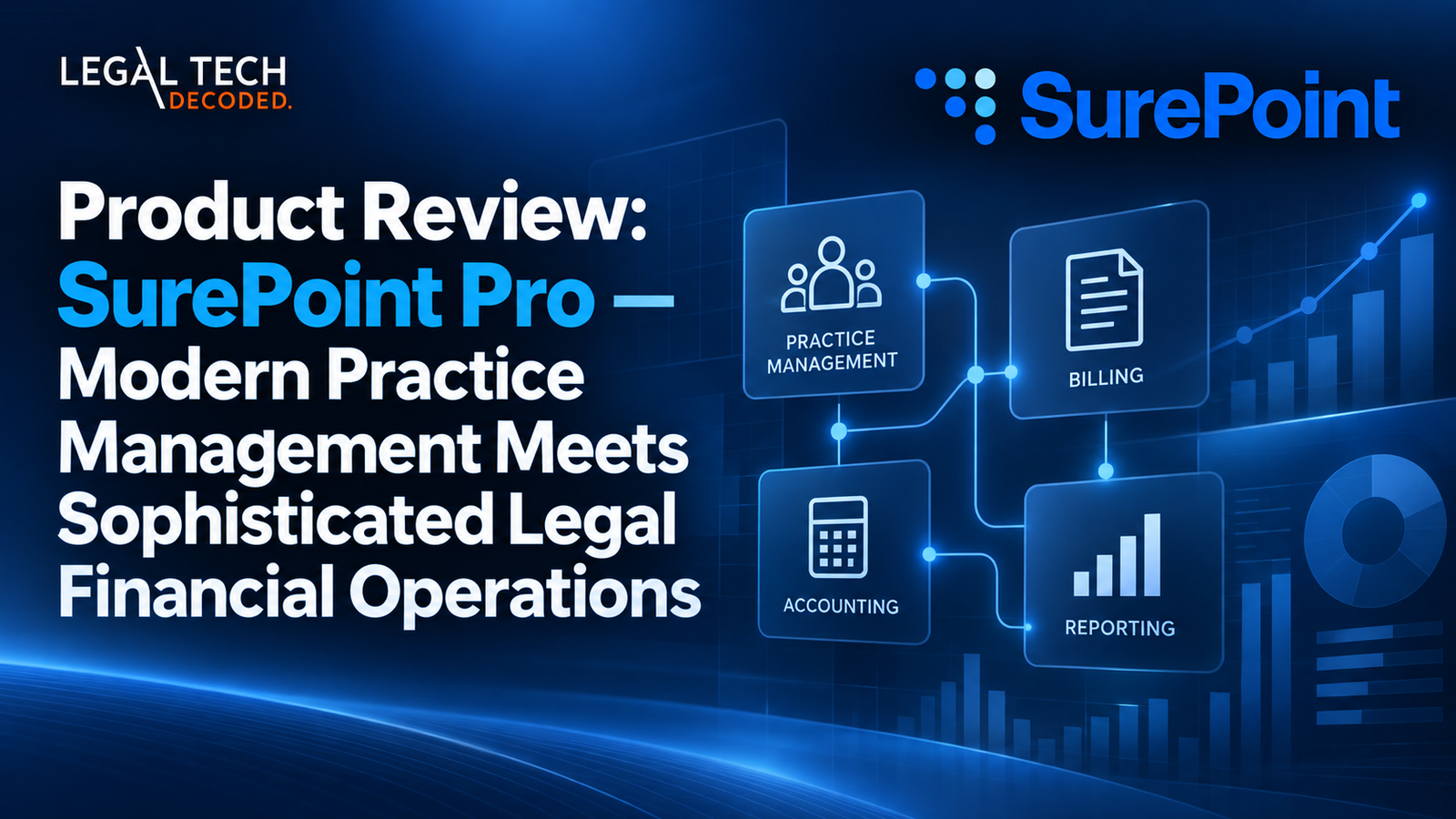
SurePoint Pro Product Review: Modern Practice Management Meets Sophisticated Legal Financial Operations
SurePoint Pro brings practice management and sophisticated legal financial operations together in a modern, responsive platform built specifically for law firms. The review examines how the system connects matter management, time capture, billing, payments, trust activity, accounting, reporting and configurable workflows without forcing attorneys and staff to move between disconnected applications. Its strongest fit is likely small and mid-sized firms that have outgrown lightweight practice management but do not want to sacrifice usability for greater financial depth. The central takeaway is that buyers should evaluate operational complexity—not attorney count alone—and focus on how well the platform manages the transitions between attorneys, billing teams, finance, administrators and firm leadership.
Filevine LOIS Product Review: The Future of Legal AI Knows Your Matter
Filevine’s LOIS represents the shift from AI as a standalone assistant to AI as part of a legal organization’s operating environment. By connecting intelligence directly to matter data, documents, calendars, tasks and workflows, LOIS helps legal teams draft with context, surface information across cases and take authorized action without continually moving data between disconnected tools. The review examines how LOIS for Word, cross-matter intelligence, reusable Skills and AI-enabled Workflows can reduce administrative steps, standardize firmwide processes and turn accumulated case data into institutional knowledge. The central takeaway: firms do not need more AI—they need secure, governed technology that removes work and helps move matters forward.
Beyond the Practice Management Platform: How Octopoda Helps Firms Get More From Aderant, Elite, Clio and Their Financial Tech Stack
When law firms become frustrated with Aderant, Elite, Clio or another core platform, replacing it can feel like the obvious next step. But the real issue may be outdated processes, inconsistent data, poor configuration, missing integrations or technology that has not evolved with the firm. In this Legal Tech Decoded review, we explore how Octopoda helps firms diagnose what is actually broken, optimize the systems they already own and strengthen financial performance through better implementation, process design and invoice-to-cash technology.

The Agent on the Hook
This was the week the industry stopped asking whether an AI agent can do the work and started answering who is accountable when it does. Crosby said it will take out professional liability insurance for its agents so they can deliver legal work without a lawyer checking every output. Legora bought Wexler to build the fact infrastructure agentic litigation will need once queries multiply by orders of magnitude. LegalOn shipped a hundred attorney-built workflows that keep a human structure around the agent rather than removing it. The agent is becoming an actor with consequences attached, not a tool a lawyer picks up. That extends the running argument one turn: the model is rented, the practice gets encoded, the meter runs on both, the dataset is the edge, everyone picked a partner, and now the field is building the accountability layer around agents that act on their own.
Student Debt Solutions Product Review: Why Bankruptcy Law Firms Are Adding Student Debt Review to Their Services
By combining technology with personalized analysis and expert guidance, SDS helps borrowers identify the repayment strategy best suited to their unique financial circumstances. It also empowers attorneys, financial advisors, employers, alumni associations, and other trusted professionals to provide meaningful support to clients, employees, and members facing one of today's most significant financial challenges.
Everybody Picked a Partner
In a single week, four legal players each shook hands with a different Big Tech firm — Willkie with OpenAI, Harvey with Microsoft, Spellbook with Google, Epiq with Anthropic's Claude. Read together, the week is the industry formalizing a division of labor. The model, the compute, and the distribution surface are being rented from the hyperscalers. The one layer nobody is outsourcing is the firm's own practice — its methodology, its data, its judgment. This extends the running argument directly: rented model, owned context (late June); encoding the playbook (July 6); reading the meter (July 13); the dataset is the edge (July 20); and now the whole field settling, out loud, on what it will rent and what it will keep.
Briefpoint Product Review
While Briefpoint continues to deliver substantial efficiency gains for litigators, the platform is increasingly helping firms and corporate legal departments solve another challenge entirely—maintaining consistency across thousands of litigation documents, attorneys, offices, and matters. For many organizations, that may ultimately become the more valuable capability.
One Agent, One Dataset
The legal AI market spent this week converging on one idea — the interface is collapsing to a single agent, and that collapse throws the entire contest onto the data layer underneath it. Litera rebuilt its brand around "one agent, one dataset." Amazon showed what a front door with no proprietary data behind it looks like. Harvey bought a company specifically to capture institutional knowledge. And Centari's CEO said the quiet part out loud: firms don't have an AI problem, they have a data problem. This extends the running argument directly — rented model, owned context (late June), encoding the playbook (July 6), reading the meter (July 13), and now the interface commoditizes while the dataset becomes the only durable edge.
The Meter is Running
The last two Gap Zones were about ownership. The model is rented, the content is rented, and the firm-context layer is the thing the firm actually owns. This week, the question shifts from what a firm owns to what a firm can measure, because the pricing of the entire stack is becoming something a firm can read off a meter, and most firms have no one reading it.
How AI Is Reshaping the Practice of Personal Injury Law: Insights from Assembly CEO Jonah Paransky
How AI fundamentally changes workflow, operational efficiency, and the economics of law firms—especially in Personal Injury. And throughout the conversation, one idea kept surfacing repeatedly. The firms that succeed in the next generation of legal operations will not simply adopt AI tools. They will rethink how work itself gets performed.
Product Review - Assembly Neos/NeosAI: The Operational Backbone for High-Volume PI Practices
Assembly Neos Review: Scaling Personal Injury Operations Through Workflow and AI
The Playbook
Kirkland & Ellis signed a deal with Syllo on Monday to formalize its litigation methodology into an encoded system. The firm named the initiative Secret Sauce Litigation. The naming is the story. Twenty-four hours later, Spellbook opened early access to Autonomous Contract Management, an agent that runs the negotiation cycle against a firm’s own history of accepted redlines. The same Tuesday, Colorado’s landmark….
Showing 13–24 of 53